From over 100,000 films, discover the handful you'll love.
Free or premium access to the world's largest documentary library.
60 films(Page 1 of 2)
Five million people gathered in Moscow to see Joseph Stalin's body after his death on March 5, 1953, as the world faced uncertainty about the future.
Eight days of negotiations in February 1945 at the Yalta Conference set the stage for post-war Europe and the onset of the Cold War.
On August 20, 1940, Leon Trotsky was attacked in his home in Coyoacan, Mexico, by a Stalinist agent wielding an ice axe, leading to his death the next day.
The Cold War began as the United States and the Soviet Union prepared their armies to prevent another devastating surprise attack after World War II.
300 Russian T-34 tanks were destroyed during the German defense of the city of Kharkov as the Soviet Union launched a massive offensive in 1943.
In 1931, Chicago lost an estimated $2 million in wages each day, contributing to the conditions that allowed fascist regimes to rise in Europe.
290,000 Allied troops crossed the Rhine in March 1945, marking a significant advance towards Berlin as the war in Europe neared its conclusion.
On March 28, 1945, General Eisenhower declared that Berlin was no longer a major military objective, allowing Soviet forces to advance.
On September 1, 1939, German troops invaded Poland, marking the beginning of World War II and escalating tensions across Europe.
One and a half million percenters, along with 20,000 rifles and 200 machine guns, arrived in Spain for monarchist militias during the 1934 uprisings.
Nikita Khrushchev was born on April 15, 1894, in Kalinovka, a village with just over 1,000 inhabitants in southern Russia.
Stalin spent hours verifying a list that sentenced 3,178 people to death or deportation while living in isolation at his heavily guarded dacha.
The siege of Leningrad lasted 900 days, resulting in an estimated death toll of at least 1 million people, one of the highest in history.
Five million people died during the famine caused by Stalin's forced collectivization policies in the early 1930s.
Total war transformed economies and societies, as the Second World War saw massive armies confronting entire populations and leading to widespread devastation.
Franklin D. Roosevelt reaches the Oval Office as Hitler rises to power during the Great Depression.
An estimated 6 million Jews were exterminated in Nazi camps, a grim reality that began to surface for the Allies in the summer of 1944.
Hitler declared war on the USA following the Japanese attack on Pearl Harbor, escalating the global conflict during World War II.
The siege of Leningrad lasted 872 days, resulting in the deaths of over a million men and women as German forces attempted to conquer the city.
90% of Stalingrad was captured by German forces during a four-month battle that ultimately led to a decisive Soviet counteroffensive.
More than a million men and women died during the 872-day siege of Leningrad as Soviet forces resisted Nazi advances in World War II.
65 million people fought in World War II, a conflict that reshaped global power dynamics and saw leaders like Stalin, Roosevelt, and Churchill rise to prominence.
The Russians prepared a total of five main defensive lines around Kursk, with the first two positioned just 10 to 12 miles apart.
Nearly 150,000 UN soldiers died during the Korean War, a conflict often referred to as "the Forgotten War."
On August 6, 1945, the B-29 bomber Enola Gay dropped an atomic bomb, called Little Boy, on Hiroshima, killing over 140,000 people by the end of the year.
Vataslaf Molotov was born on February 25, 1890, in Kukara, Russia, and became a key figure in Soviet politics under Joseph Stalin.
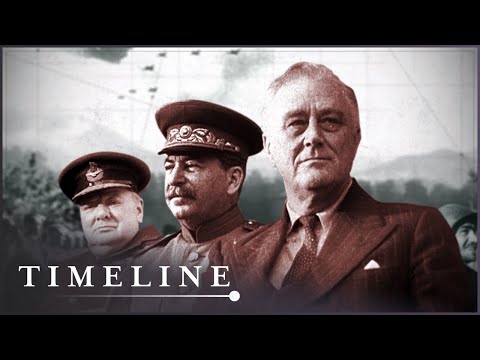
In February 1945, Stalin, Roosevelt, and Churchill met at the Yalta Conference to negotiate the post-war order, revealing a complex interplay of espionage and psychological tactics.
Churchill, Roosevelt, and Stalin navigate power dynamics during World War II.
40 million men, women, and children lost their lives during World War II, leaving Europe in ruins and facing the daunting task of rebuilding.
Pearl Harbor's attack in 1941 prompted a massive enlistment of American soldiers, significantly altering the course of World War II against Japan and the Axis powers.
The Act of Germany's Capitulation was signed in Berlin on May 8, 1945, marking the end of World War II in Europe.
The siege of Leningrad lasted for 900 days, resulting in the deaths of over 1.5 million civilians from starvation and bombardments.
As many as 70,000 people are instantly killed by the atomic bomb dropped on Hiroshima on August 6, 1945, marking the start of the nuclear age.
Cologne falls to the Allies in March 1945 as Stalin targets Berlin next.
World War II reaches Germany on January 28, 1945, marking a hundred days of terror.
In 1941, as German forces advanced on Moscow, Stalin declared martial law and ordered the execution of looters and suspected spies.
670,000 people were arrested and 376,000 executed during Stalin's Great Purge, reflecting the violent methods of totalitarian regimes in the 20th century.
The documentary reveals the unrecognized suffering of Germans in Russian gulags during WWII.
Stalin, Churchill, and Roosevelt plan an attack on Western Europe during World War II.
Idi Amin's brutal regime in Uganda is examined, highlighting his legacy and the historical context of his leadership compared to figures like Stalin.
177,000 monks were killed during a purge in 1937 as the Soviet regime sought to eliminate Buddhism in Mongolia.
About 100,000 crosses adorn a small hill in Lithuania, symbolizing the nation's struggle against Soviet oppression and its enduring spirituality.
Nancy Astor confronts Stalin in Russia about his human rights record during her visit.
The United States imprisons over 20% of the world's prisoners, surpassing Stalin's Gulags.
Kaley Cuoco shares her competitive pingpong antics and humorous cheating tactics on set.
Kaliningrad houses the headquarters of the Russian Baltic fleet and is home to Iskandar nuclear missiles pointed towards Europe.
The video discusses Stalin, Churchill, and the influence of social media on public perception.
On the day of the referendum, polling stations in Crimea see a mix of voters, including those from the Crimean Tatar community, who largely boycott the event.