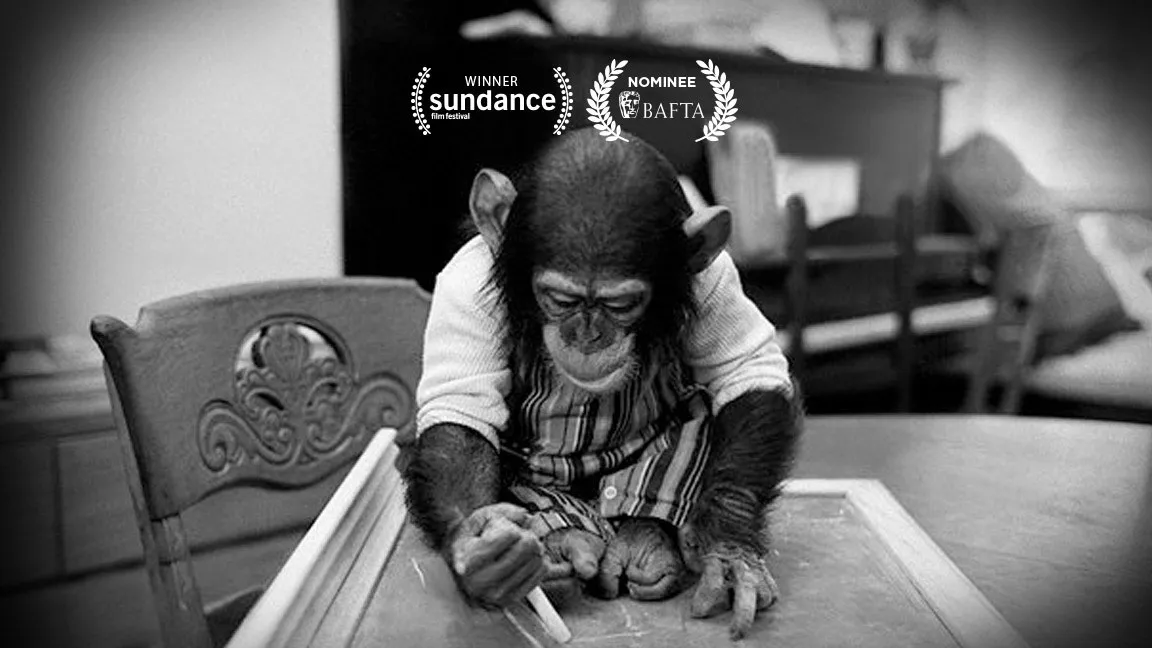
In 1973, a two-week-old chimpanzee named Nim Chimpsky was taken from Oklahoma to New York City to participate in a language acquisition study.
“The world will be a different place once you've seen it through his eyes.”
Synopsis
In 1973, a two-week-old chimpanzee named Nim Chimpsky was taken from Oklahoma to New York City to participate in a language acquisition study.
Go deeperPeople
View all →


Synopsis
In 1973, Nim Chimpsky, a young chimpanzee, was taken from Dr. William Lemmon's Institute for Primate Studies in Oklahoma to New York City for a language acquisition study led by psychologist Herbert Terrace at Columbia University. Raised in a human household by Stephanie LaFarge, Nim learned American Sign Language with the help of students. The film details the challenges of the experiment, including Nim's interactions with humans and the ethical concerns surrounding his treatment and the research conducted.
What Critics Say
 The Guardian
A documentary about a radical 1970s social experiment shows human beings in a pretty poor light.
Deep Dive
Why Watch
- See Nim's unique upbringing in a human environment.
- Meet the researchers behind the controversial language study.
- Find out what happened to Nim after the experiment ended.
Did You Know
- Nim Chimpsky was born in 1973 and separated from his mother two weeks later.
- Nim was raised in a home where no one was fluent in American Sign Language.
- Nim injured several researchers as he grew larger and stronger during the study.
- After the experiment, Nim was sold to a pharmaceutical testing lab before being rescued.
Perfect For
Frequently Asked Questions
Who directed the documentary Project Nim?
Project Nim was directed by James Marsh.
What was the purpose of the research project involving Nim Chimpsky?
The research project aimed to determine whether a primate could learn to speak using American Sign Language.
What conclusion did Dr. Herbert S. Terrace reach about Nim's use of sign language?
Dr. Terrace concluded that Nim's use of sign language seemed to be mimicry to receive a reward rather than indicating an understanding of grammar.
Awards & Festivals
What are people saying?
Play More Like This



















Related Films
Is this your film?
If you made this film or hold the rights to it, we'd like to talk. We can license it and pay you a share of what it earns.







Comments